

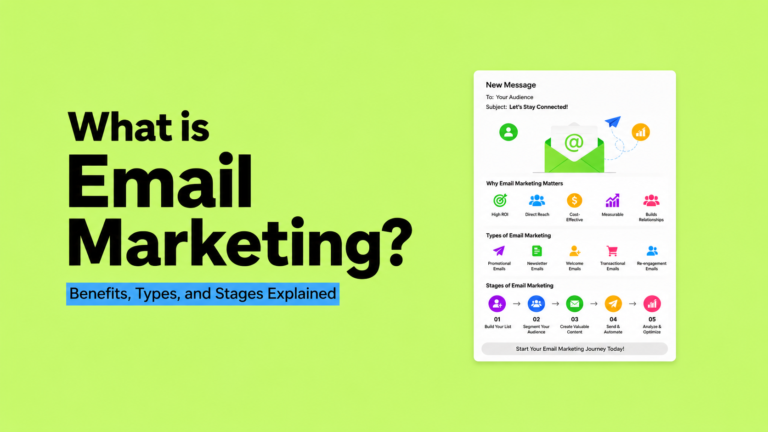
Email marketing is the channel that if you are building a blog, an online business, or any type of audience online, you can’t afford to not pay attention. Social Media Reach is on the decline. The price of paid ads is increasing every year.
Table of Contents
ToggleSEO results can take many months. However, an email list is an asset that you own and control- and the statistics show that this channel is consistently effective.
I will provide you with an explanation of what email marketing actually is, why it works, the various types of email marketing, and how creating a proper email marketing funnel goes from start to finish and what you need to get started.
What Is Email Marketing?
Email marketing is the act of sending out informative and meaningful emails to people who have agreed to receive them from you, and have a specific purpose in mind like a sale, a click or a sign-up.
It’s one of the most established digital marketing methods and still has a massive lead as one of the most effective digital marketing channels in 2026.
Email marketing isn’t spam. It all comes down to permission. All members of a legitimate email list have opted-in to receive your emails. This is the reason that email is more successful than almost any other medium of conversion.
Email marketing is nothing more than three things-
- A list- a group of email addresses from people who wish to hear from you.
- A platform is a piece of software where you’re able to store your list and your emails (Kit, Mailchimp, MailerLite, etc.).
- A strategy- a plan to send; when to send; and who to send to
Email marketing can be as basic as a once-a-week newsletter, or as intricate as a multi-step sequence of content that is created and sent to customers over a series of weeks based on their behavior.
My experience while building webjinnee, when I began, I only took SEO traffic into consideration.
The importance of email marketing was a luxury. Once I created a list and began sending out regular e-mails, my affiliate income, product sales, and return traffic all had a significant boost.
The only thing that made the difference is that my subscribers had already been engaged and trusted my recommendations in the form of e-mails.
I have found that every time I send out an email to my list I get better conversions than I do from a cold click from Google.
You May also Like:- Best Gpl Sites For WordPress Plugins and Themes
Why Email Marketing Still Works in 2026?
However, before we get into the types and stages, let’s first consider the data that proves why email marketing is vital to any online business-
It has a massive reach-
In 2026, there will be around 4.73 billion users of email, which is more than 50% of the global population (Source: Statista / Radicati Group, cited by CodeCrew 2026).
More than 392 billion emails are sent and received on a daily basis (Data: Stripo / Statista) (Source: WebToffee 2026).
According to DemandSage email marketing statistics 2026, the 99% of email users check their email box at least once a day and some check it up to 20 times every day.
58% of people check their email before their social media news feeds or news (Source: DemandSage 2026)
You May also Like:- Best 5 Sites to Buy Google Reviews
It is an ROI that is second-to-none
The ROI of email marketing is in the range of $36 to $42 for every $1 invested, which is the highest among all digital marketing channels (Source: CodeCrew 2026, as cited by Litmus / DemandSage)
For comparison: Paid search yields about $2 per dollar, social advertising yields about $2.80 per dollar and display returns about $1.35 per dollar (Source: DigitalApplied Email Marketing Statistics 2026).
Retail and e-commerce companies experience even better returns – as high as $45 per dollar invested (source: DemandSage 2026).
According to the Marketing LTB Email Statistics 2026, the global email marketing market is set to grow to $17.9 billion by 2027.
Email ROI Calculator
Consumers prefer it-
60% of consumers prefer brands to contact them via email over any other channel (Source: Marketing LTB 2026)
Marketing emails can impact purchasing decisions for 59% of consumers (Source: DemandSage 2026)
Millennials and Gen Z say they prefer brands to reach them via email – 79% and 57% respectively (Source: Marketing LTB 2026).
It is used by marketers-
Email marketing is tied for #2 with organic social media as the most used marketing channel for every business size (Source: HubSpot State of Marketing 2026).
Email is the top channel for marketers, marking 41% as their top channel (Source: Litmus, cited by Emailmonday 2026).
Email is the top choice of marketers for lead generation, with 89% saying that it is their main source (Source: EmailChef 2026).
According to EmailChef 2026, 81% of SMEs are utilizing email marketing to engage customers.EmailChef 2026 revealed that 81% of SMEs are leveraging email marketing to connect with customers.
You May also Like:- WorldPressIT Review- GPL Plugins and Themes for WordPress
Key Benefits of Email Marketing
- Own Your Audience-Build your own loyal followers.
It’s the most significant advantage which most individuals undervalue. Your email list belongs to YOU. You’re not leasing access to your audience from one platform that can alter its algorithm at any time.
Facebook, Instagram and YouTube are the ones that control social media reach. As soon as you change their algorithm, your reach decreases.
You will not be deleted from your email list. When WebToffee says this in their analysis for 2026, it’s true: “Unlike social media followers, your email list is yours- you’re not at the mercy of changing algorithms or ad costs.
- 2nd most ROI from any Digital Channel.
As mentioned above, the ROI for email is $36–$42 for every $1 spent. No other channel is as effective on the scale. This is not new- this is the case for more than ten years, and increasing the gap day by day with the per-send revenue contributed by the AI personalization.
- Direct, Personal Communication
An email shows up in a personal email inbox and not into an open feed. The intimacy of that is something different, than a social media post. If you send them an email, you’ll get their full attention more than you normally do on other platforms.
- Highly Measurable
With e-mail marketing you have detailed information on who opened your e-mail, who has clicked, who has purchased, and who has unsubscribed. These data can be used to fine-tune your strategy on an ongoing basis, something that you cannot do on most offline channels.
- Automation makes your effort multiply.
Automated email sequences operate for you 24/7- with no extra work. A sequence that is triggered when someone signs up, a product launch funnel, or an abandoned cart email- they’re all free-flying, and you can get a ton of value out of them, no matter how much time you invest in them, which is 1 hour for each of them.
- Segmentation can generate an astounding amount of revenue.
According to Leadoom’s analysis of DMA data, segmented campaigns are 760% more profitable than non-segmented campaigns. It’s much more effective to send the right email to the right subscriber at the right time, rather than sending the same email to everyone.
- Supports all types of business
There are several different types of businesses that are able to benefit from the power of email marketing, including e-commerce stores, bloggers, SaaS companies, service providers, coaches, course creators, affiliate marketers, and non-profits. All the principles involved apply to all products.
You May also Like:- Top 10 Group Buy SEO Tools Providers list
Types of Email Marketing
Not every email that’s sent as a marketing message is identical. These different types are used for various purposes as part of your overall strategy.
- Newsletter Emails
A newsletter is an email you send to all your subscribers on a periodic basis, whether it’s once a week, once every two weeks or once a month. Provides content, updates, tips or insights to help engage your audience between purchases or visits to your website.
Bloggers and content creators usually begin their blogs with newsletters. They develop a habit of hearing from you and stay top of mind with your brand.
Use for: Content creators, bloggers, newsletters businesses, B2B organisations
For instance, every week, a collection of your top articles, industry news, or actionable tips for your audience.
- Welcome Email Sequences
Welcome sequence” refers to the series of emails that are sent automatically to new subscribers after their sign up. It’s important because it’s your first impression, and it’s your first impression, period.
This is compared to an average open rate of 21-25% for an average campaign. More people will read your welcome email than any other email you send!
A great welcome sequence welcomes you, sets expectations, provides any lead magnet you promised and leads your new subscribers to your most useful content or offer.
For all email marketers: no choice but for this to be the best.
Email 1: Welcome + Lead magnet. Email 2: Your Story and ‘Why’ you exist. A great free resource you have: EMAIL! Email 4: Your best offer/piece of product.
- Promotional Emails
Promotional emails are those that give you an announcement of a sale, discount, product launch or limited time offer. They are meant to make people take a particular action, such as buying something, signing up or clicking.
If sent at the right frequency at the right segment, these emails are effective. They are sent to uninterested subscribers and contribute to high unsubscribe rates and degrade sender reputation. Marketing LTB data from 2026 shows 96% of subscribers ended up unsubscribed due to the frequency of email messages.
Ideal for: E-commerce websites, course developers, product release, seasonal sales, etc.
40% OFF ALL COURSES FOR 48 HOURS (Example: Black Friday Sale)
- Transactional Emails
Transactional emails are generated by a specific event the user is involved in, for example, an order confirmation, shipping notification, password reset or receipt. They are not sent as marketing emails, but they see openings that are very high because they have content that the recipient is looking for.
Smart marketers leverage transactional emails to provide product suggestions, referral links, or review requests- and transform a simple email into a revenue opportunity.
Ideal for: Ecommerce, SaaS, businesses that have customers making transactions
Example: An order confirmation email with some relevant products recommended.
- Automated Drip Sequences
Drip sequences consist of a series of pre-written emails that are automatically sent out over a certain timeframe- usually to nurture leads from awareness to purchase. A drip sequence is designed to educate, build trust and drive subscribers to a certain call to action, unlike a welcome sequence which introduces you to the subscriber.
This is a great option for course creators, Saas businesses, high ticket offers and B2B lead nurturing.
This is an example of the 7-email sequence that informs the subscribers of the challenge, presents your solution, responds to any objections, and concludes with an offer.
- Behavioral / Triggered Emails
Behavioral emails are triggered as a result of a subscriber’s actions- or inaction. They can be the most advanced kind of e-mail marketing, and they’re the most converting.
Examples of behavioral triggers-
A reader clicks a link that is about topic X → gets a series of follow-up emails about topic X
A subscriber comes to your pricing page but they’re not going to subscribe → they get a targeted discount e-mail.
If a subscriber hasn’t opened one of your emails in 90 days, he/she is sent a re-engagement campaign.
A user buys product A, gets a series of messages about product B
Despite being only 2% of all e-commerce email, automated emails accounted for 37% of the total revenue from e-commerce emails in 2024, according to Omnisend data cited by CodeCrew 2026. This is what behavioral targeting is all about.
Ideal for: All email marketers who have a platform with behavioral automation (Kit, Klaviyo, ActiveCampaign).
- Re-engagement Emails
Re-engagement emails are sent to those subscribers who did not open or click your email in a specified timeframe (usually 60-180 days). They aim to either renew the subscriber or drop him/her from your list.
This is important to deliverability. Low engagement rates are a red flag to Gmail. When you send to lots of subscribers who aren’t interested in your updates, email providers begin to pass your email messages to spam — harming the rest of the list. Regular cleaning of your list with re-engagement campaigns helps maintain your sender’s reputation.
Ideal for: An existing email list that has at least 6 months of data
For instance: “We haven’t heard from you for a while – do you still want to be a part of us?” To continue, click here; otherwise, we’ll unsubscribe you in 7 days.
- Abandoned Cart Emails (E-commerce)
In abandoned cart emails are among the highest ROI automations for ecommerce companies. They attract visitors who have placed an item in their shopping cart but haven’t checked out.
Abandoned cart emails have the highest CTR across all types of emails in all automation types (Average CTR 23.33% Source: Analyzify / InboxAlly, cited by CodeCrew 2026). Although cart abandonment flows only represent about 5% of all email, they generate almost 20% of email marketing revenue.
Ideal for: Ecommerce stores, digital product sellers.
You May also Like:- GPL Chimp Review- Best GPL Plugins and Theme Site
The Stages of Email Marketing (The Full Funnel)
Email marketing is more than just sending emails. It’s a system that has distinct stages, and knowing each stage will assist you in creating a system that will work.
Stage 1: List Building
You can’t send any of your emails without having subscribers. Building a list involves encouraging people to sign up for your list by agreeing to provide their e-mail address willingly in return for something you can provide them.
Tactics that are important for the list building-
- Lead magnets: A free resource (ebook, checklist, template, mini-course) that helps with a problem for which someone is seeking a solution by signing up for an email list.
- Opt-in forms: Forms that are located on your website (in the header, within your content, as a pop-up or in the footer)
- Single pages that are created to specifically collect email sign ups, and have no clutter.
- Content upgrades: An additional resource that is offered in the article and is very relevant to the topic of the article.
Social media promotion- getting visitors to your e-mail list!
Taking the average of all verticals, the average opt-in rate is 1.95% (Source: CodeCrew 2026). For every 100 people that visit your opt-in page, about 2 of them will Sign Up. This rate depends on your lead magnet, landing page copy and form placement.
Stage 2: Onboarding (The Welcome Sequence)
The onboarding process starts when someone joins your company. This is the one time in your entire email marketing career that it’s imperative you’re right. The average open rate of welcomes emails is 83.6% (Source: GetResponse 2026).
A good onboarding sequence has 4 components-
- Provides the lead magnet as soon as promised
- Introduces themselves and their email and why people should read it
- Establishes expectations: What will they be sent, how frequently and what will they get.
- Delivers the best content or offer to your new subscriber
Stage 3: Nurturing
The next phase after the subscription is successful is called nurturing. It is the continuous process of providing value, trust and intimacy by having consistent communication.
Nurturing emails don’t have to be about selling. They are focused on helping your subscribers improve in some way- to be more knowledgeable, more skilled, more self-assured. If your subscribers are regularly getting value from your e-mails, they trust you. If you are trusted, they’ll purchase from you.
That’s why it is important to be consistent. You will always get more out of a list that hears from you on a regular basis (even weekly) than a list that only hears from you when you have something to sell.
Stage 4: Segmentation and Personalization
The more people get added to your list, the less effective you’ll find it to be, to send the same e-mail to them all. Segmentation involves breaking your list into smaller groups, such as those that share similar traits, such as behavior, interests, location, purchase history or engagement level.
Segmentation can be quantified and is meaningful. Leadoom 2026 cited that segmented campaigns make 760% more money than non-segmented ones (Source: DMA). Subject lines with personalization rates up to 26% higher in terms of open rates (Source: DigitalApplied 2026).
Modern email platforms such as Kit support the concept of segmentation, which is easy when using the tag-based subscriber model. Each click or download of a particular link or resource puts a tag on each subscriber, which may initiate a personalized path of follow-ups.
Stage 5: Conversion
The conversion stage is the place in which you are making an offer. It can be a sales conversion, an affiliate recommendation, signing up for a course, requesting a service, etc., anything that can bring in a revenue.
There are several criteria for conversion emails to be effective-
- The subscriber has been cared for and is a part of your trust.
- The offer is directly applicable to their interests (segmentation, that is).
- There is one clear call to action in the e-mail.
- The moment is perfect- following a value sequence, while a relevant event is occurring, or to a behavioral event
According to Source- FirstPageSage 2025 (HubSpot Statistics 2026), the conversion rate for B2C brands is 2.8% while B2B brands have a conversion rate of 2.4%. Comparatively, the rate of conversion on all traffic is less than 2% e-commerce average.
Stage 6: Retention & Re-engagement
The bottom of the funnel is not the end, it’s the loop. If you already have customers who are familiar with your brand, they are likely to be your ideal audience for your next marketing campaign. The cost of retaining is much less than the cost of acquisition.
Email marketing is the most inexpensive retention option to have. A post-purchase nurture sequence, exclusive offers and loyalty programs all help to keep customers and boost their LTV.
Re-engagement campaigns can get them to re-engage when they go AWOL – or remove them from your list in a healthy manner to preserve deliverability.
You May also Like:- 7 Best Sites to Buy Facebook Reviews And Free
What Makes a Good Email Marketing Strategy?
There are some key components to a good email marketing campaign–
Use one purpose per e-mail: Each e-mail should have one main objective. There’s a distinct difference between informing, nurturing and converting. Avoid attempting to perform all three of the tasks in a single e-mail.
Regular sending schedule: You should read your emails if you do it regularly. Choose to send daily, weekly or bi-weekly and then stick to it. 96% of subscribers report they’ve un subscribed due to email frequency, but not because they are not being sent less, it’s because they are not being sent the right emails to the right people.
Mobile optimization: In 2026, about 60% of emails will be read from a mobile device. (Source: EmailChef 2026). More than half of your potential readers will miss out on a non-mobile friendly email. More than 50% of users take out an email from their account right away if it is not optimized for mobile (Source: Marketing LTB 2026).
Effective Email Subject Lines: Your email subject line is essential to whether your email is opened or not. On average, AI-generated subject lines are 26% more successful than those written by humans (Source: DigitalApplied 26). One of the highest leverage activities in email marketing is testing your subject lines (A/B testing).
In 2026, there will be no opting out of email authentication: DMARC, DKIM and SPF. In 2024, Google and Yahoo adopted the DMARC mandates for bulk senders, thus establishing a structural distinction between legitimate and illegitimate senders.
There are 45 percentage points between the placement rates of properly authenticated and unauthenticated senders in the inbox (Source: DigitalApplied 2026).
Email Marketing Metrics You Should Actually Track
Not all email metrics are equally useful in 2026. Here is what actually matters-
| Metric | What It Measures | 2026 Benchmark |
| Click-Through Rate (CTR) | % of recipients who clicked a link | ~2.5% across industries (HubSpot 2025) |
| Click-to-Open Rate (CTOR) | Clicks as % of opens | ~10–15% is healthy |
| Conversion Rate | % who completed desired action | 2.4–2.8% (FirstPageSage 2025) |
| Revenue Per Recipient | Revenue generated per email sent | Varies by industry |
| Unsubscribe Rate | % who opted out | Under 0.5% is healthy |
| List Growth Rate | Net new subscribers per period | Track month over month |
| Deliverability Rate | % of emails reaching inbox | Above 95% is target |
Common Email Marketing Mistakes to Avoid
Here are a few common email marketing mistakes that you should steer clear of.
Buying email lists
Listed contacts are people that you have bought who never wanted your contact in the first place. Sending to them causes your sender reputation to be damaged, increases spam complaints and may lead to your domain being blacklisted. Never buy a list.Never purchase a list.
Using an automatic mail merge for all contacts.Mailing the same letter to all contacts.
Sending one email to everyone on your list is the quickest route to killing engagement: “batch and blast. Gmail’s spam filters negatively reward low engagement in 2026. Google considers you to be spam if you send to 10,000 and only 50 click (Source: Leadoom 2026).
Ignoring mobile optimization
More than half of email opens are on mobile. Most people just delete emails with small text, concepts that don’t make sense, or missing images.
Not cleaning your list
An email list isn’t a vanity metric. A smaller list of engaged members is always better than a larger one of passive members. Re-engage inactive subscribers, and delete them if they do not respond.
Shooting without a target.
Each e-mail message must have a single purpose. An email with a purpose of informing, promoting a product, sharing a case study, announcing a new feature, and more, doesn’t convert on any of them.
No welcome sequence
In case you have an opt-in form but no welcome sequence then you’re losing your most engaged moment. It is the phrase “Fresh Subscribers” which are most engaged directly after signing up. One of the most prevalent and expensive email marketing mistakes is not having a welcome sequence.
You May also Like:- PluginsforWP Review- Best Site For GPL Plugins and Themes
How to Get Started with Email Marketing?
If you need to get started with email marketing, here are a few tips.
Email marketing is just like any other marketing campaign; it needs to get started by having four things-
Step 1: Choose an email marketing platform
Kit (formerly ConvertKit) is one of the best places to start for anyone creating, blogging, or running a WordPress business. The free plan will allow you to send up to 10,000 subscribers emails, have unlimited landing pages, forms and even sell digital products- for free. Alternatives are MailerLite ($10/month), Brevo (free as much as 300 emails/day) and Mailchimp (limited free plan).
Step 2: Create a lead magnet
Offer a motivation to sign-up. A lead magnet is a free tool, guide, checklist, template, mini-course or resource that helps people with a particular problem in their lives. The more focused and practical your lead magnet is, the more you’ll get people to sign up.
Step 3: Configure your form and landing page!
Incorporate opt-in forms into your website in high-traffic areas such as within your content, in the sidebar, as a pop-up, and/or in the footer. Have a special landing page for your lead magnet and have one call to action.
Step 4: Write your welcome sequence
It is very important to send at least 3–5 welcome emails before launching. The most significant e-mails you will ever send. Provide your lead magnet, introduce yourself, set expectations, and direct new subscribers to your best content, and what’s most relevant to you.
If you have all four of these elements, you’re ready for a working email marketing system. After that – segmentation, behavioural automation, advanced sequences- it is optimization.
You May also Like:- 29+ Best Group buy SEO Tools Providers (Just Rs. 99/-*)
Conclusion
Email marketing is not new- but, in 2026, it’s more powerful, more measurable and more available than ever before.
The basics have stayed the same. Create a mailing list of people wishing to get in touch. Deliver consistent value. Segment on a progressive basis. Automate anything you can! Make offers to people who are ready to purchase. Keep the customers you currently have on board.
Scale has changed but nothing else. There are 4.73 billion email users in the world, and the average ROI is 36–42 per dollar invested, and nothing makes it easier to start a serious email marketing system than to do it for free with up to 10,000 subscribers with the tools like Kit.
When you’re done with this guide, take this one with you: Your email list is your only audience! You can have your social media(s) suspended. Search rankings can plummet in no time at all. The price of an ad can increase by 200% in a quarter.
However, one of the most enduring assets a content creator or online business can boast is a well-constructed email list, that is, a group of subscribers who have opted in and believe that what you’re sending them is of value.
The optimal time to begin creating your list was the day you launched your website. The best time is today, the second is now.
You can begin by creating a lead magnet, creating a free Kit account, constructing your welcome series, and sending your initial e-mail. With segmentation, automation, and monetization coming at the end, it’s the foundation that’s the most essential.
